Trying to identify an unknown zoanthid can be one of the most enjoyable and frustrating parts of collecting zoas.
At first glance it sounds simple. Find a photograph that looks the same and you have your answer. In reality, the same zoanthid can appear surprisingly different depending on aquarium lighting, camera settings, polyp maturity, water conditions and even how fully the polyp is open.
There is another complication too. Most of the familiar names used by reefkeepers are hobby trade names, not scientific classifications. Names such as Sunny D, Fruit Loops and Candy Apple Red are useful ways for collectors to describe recognised colour morphs, but they do not function like formally defined species names.
That means good zoanthid identification is less about matching one colour and more about comparing the complete appearance of the polyp.
What Should You Look at When Identifying a Zoa?
A fully open zoanthid polyp can be broken down into several visually useful areas.
For Zoa Scan, the most useful features are the centre, body or oral disc, and skirt, alongside any rings, speckles, gradients or repeating patterns.
When comparing two morphs, work from the middle of the polyp outwards rather than concentrating on whichever colour appears brightest.
| Heading | Heading |
|---|---|
| Mouth | Colour immediately around the central opening |
| Centre | The innermost coloured area surrounding the mouth |
| Oral disc / body | Main surface of the polyp |
| Rings | Circular bands separating different colour zones |
| Markings | Speckles, streaks, radial lines, patches or gradients |
| Skirt | Tentacles surrounding the edge of the polyp |
| Skirt pattern | Solid, alternating, tipped or multi-coloured tentacles |
| Polyp size | Small, medium or relatively large appearance |
| Colony appearance | Spacing, consistency and appearance of multiple polyps together |
Start With the Mouth and Centre
Begin at the very centre of the polyp.
Look at the colour of the mouth and then the area immediately surrounding it. Some morphs have a sharply contrasting centre, while others transition gradually into the rest of the oral disc.
Ask yourself:
- - Is the mouth a different colour from the surrounding centre?
- - Is the central colour solid or irregular?
- - Is there a clearly defined ring around it?
- - Does the colour radiate outwards?
- - Are there small markings, speckles or streaks around the centre?
These details are often more useful than simply describing the entire zoa as red, green, orange or blue.
Two morphs may share the same dominant colour while having completely different central patterns.
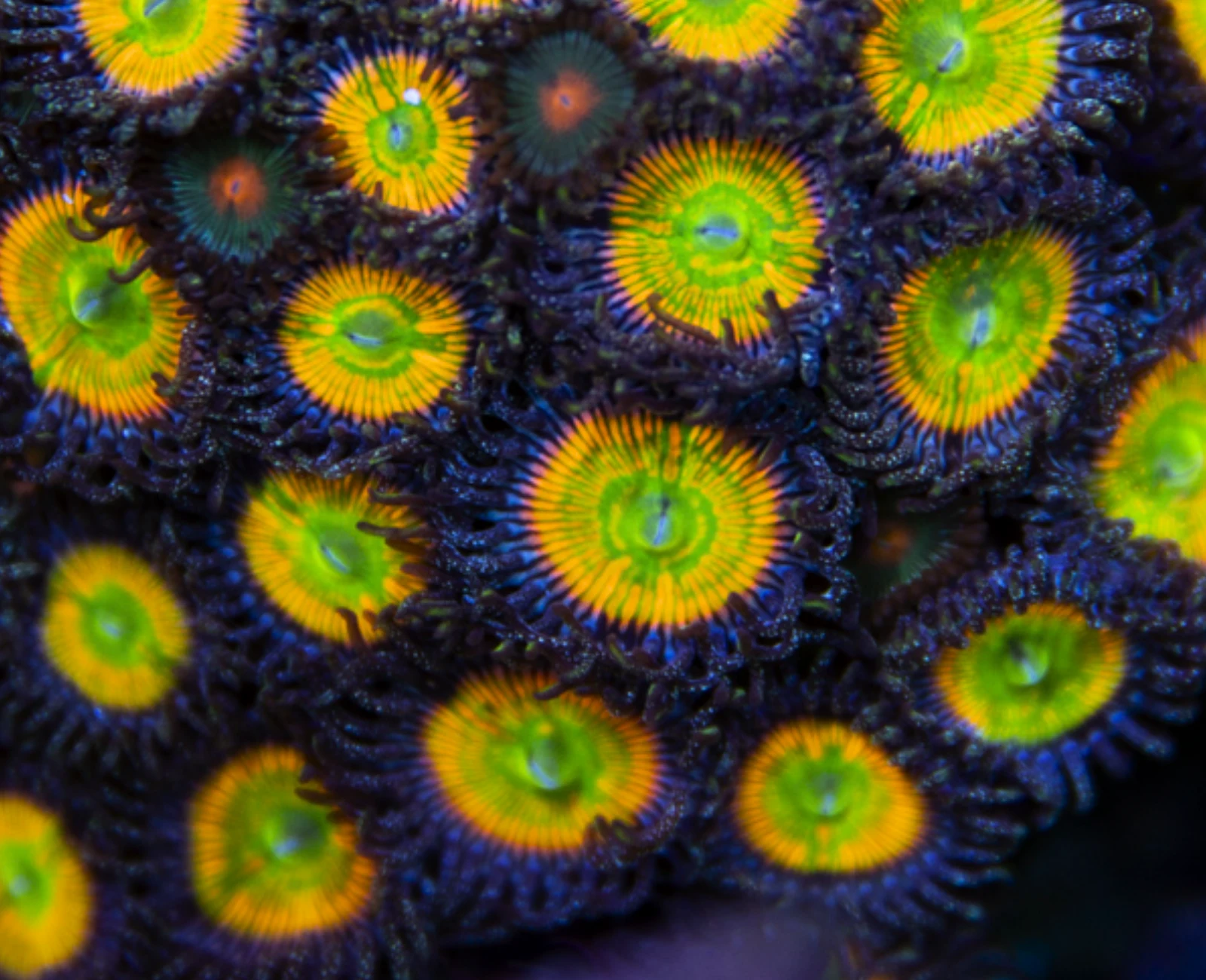
Sunny D
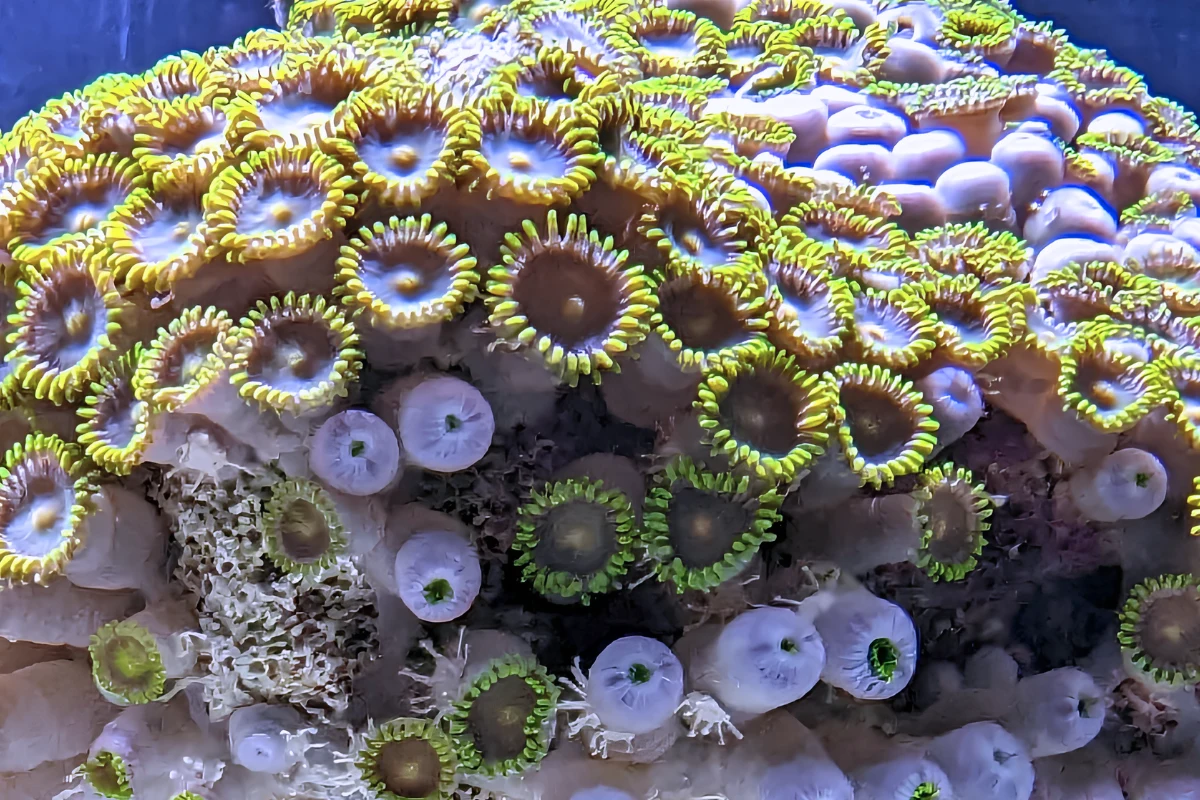
Sunny D is a named zoanthid morph recorded in the Zoa Scan UK zoanthid catalogue. It is also recorded under the alias Sunny Delight. Its observed colour profile combines a yellow centre, green body or oral disc and green skirt, arranged in a radial pattern. These recorded traits help reefkeepers compare specimens, although appearance can vary with aquarium lighting, photography and colony condition. Zoa Scan records this morph as easy in difficulty, with moderate lighting and low–moderate water flow, together with a fast growth rate. These care details are catalogue observations rather than guarantees, so stable reef conditions and gradual acclimation remain important. Use this profile to identify Sunny D zoanthids, compare current UK retailer observations and review captive-grown community frags. Check the complete colour pattern and available source evidence rather than relying on the trade name alone.
Open catalogue record →Examine the Oral Disc
The oral disc is the broad, flat surface between the mouth and the outer skirt.
This is where many of the patterns associated with named zoanthid morphs appear.
Rather than recording only its main colour, look for how that colour is distributed.
- - Solid colour
- - Concentric rings
- - Radial streaks
- - Speckling
- - Mottling
- - Colour gradients
- - Irregular patches
- - Contrasting outer ring
- - Repeating patterns around the mouth
Complex morphs can contain several clearly separated colour zones within a single oral disc.
This is why describing a zoanthid as simply "orange with a green skirt" is rarely enough for a confident identification.
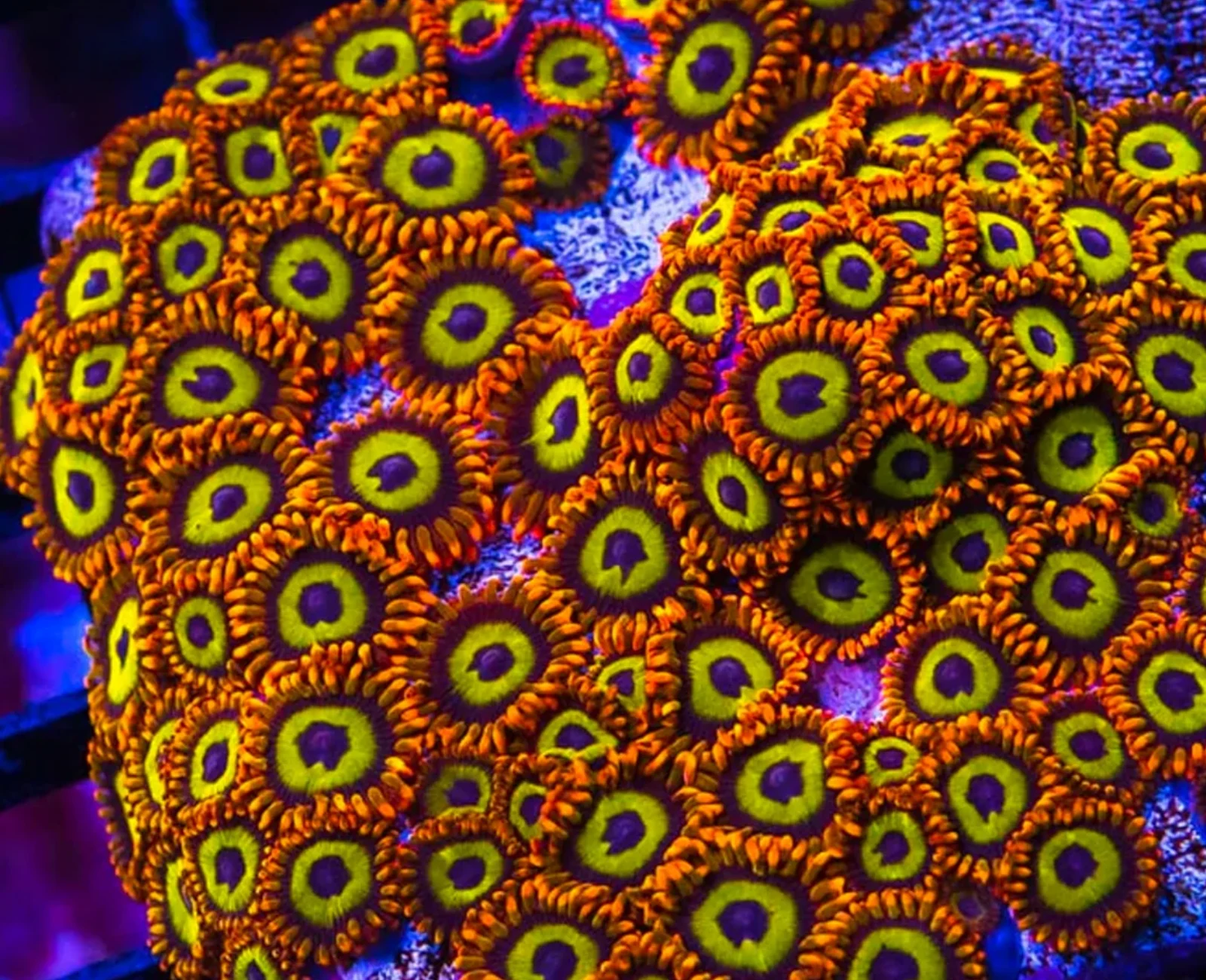
Fruit Loops
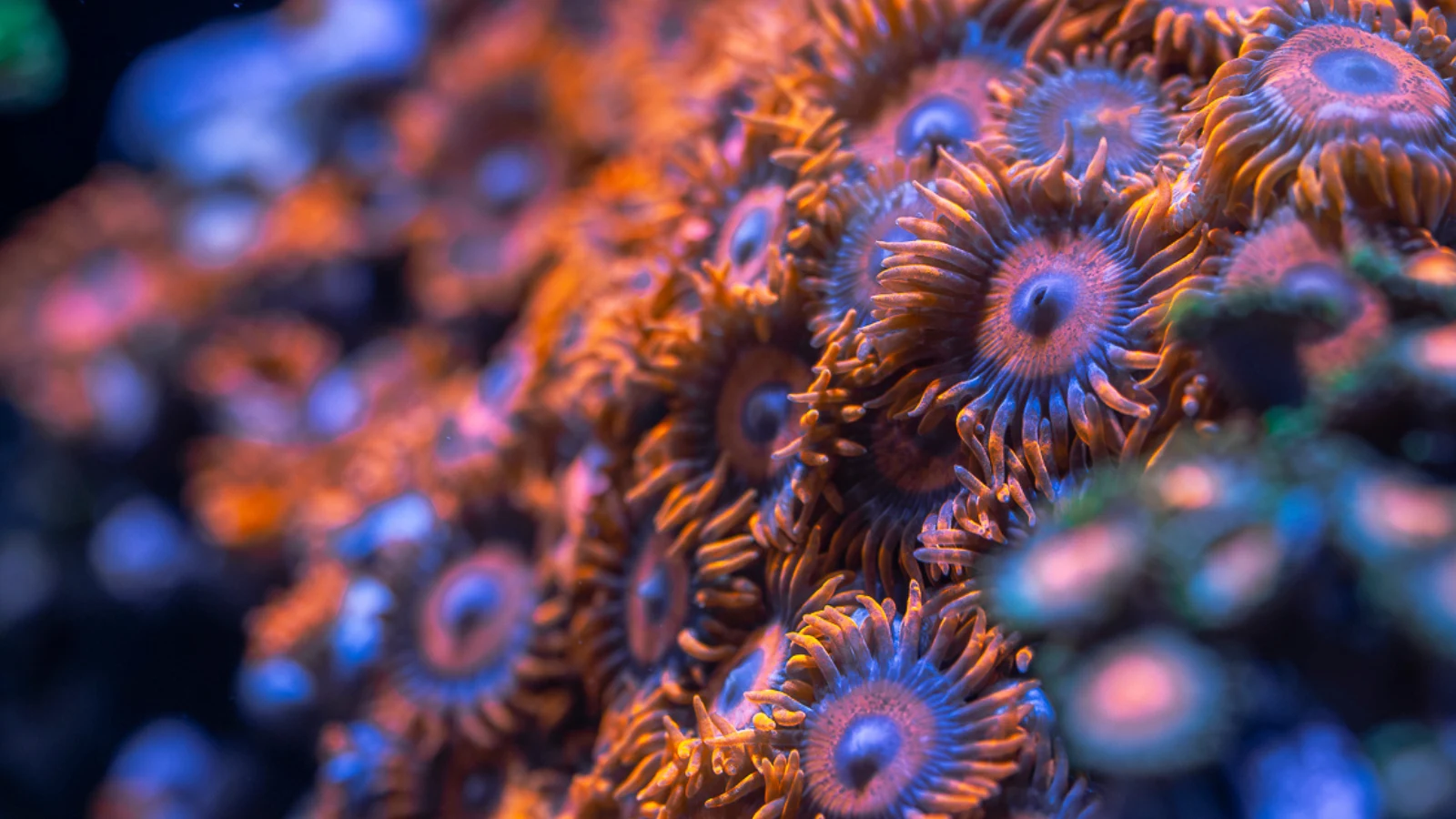
Fruit Loops is a named zoanthid morph recorded in the Zoa Scan UK zoanthid catalogue. It is also recorded under the aliases Froot Loops and Fruit Loop. Its observed colour profile combines a purple centre, yellow body or oral disc and orange skirt, arranged in a radial pattern. These recorded traits help reefkeepers compare specimens, although appearance can vary with aquarium lighting, photography and colony condition. Zoa Scan records this morph as easy in difficulty, with moderate lighting and low–moderate water flow, together with a fast growth rate. These care details are catalogue observations rather than guarantees, so stable reef conditions and gradual acclimation remain important. Use this profile to identify Fruit Loops zoanthids, compare current UK retailer observations and review captive-grown community frags. Check the complete colour pattern and available source evidence rather than relying on the trade name alone.
Open catalogue record →Look Closely at the Skirt
The ring of tentacles around the edge of a zoanthid is commonly called the skirt by reefkeepers.
Skirt colour is one of the easiest characteristics to notice, but there can be more information there than first appears.
Look at whether the skirt is one consistent colour or whether individual tentacles contain different colours at the base, middle or tip.
Also consider whether alternating tentacles appear different from one another.
Identify the Colour Zones
A useful way to compare zoanthids is to mentally divide the polyp into colour zones.
For example:
- 1. Mouth
- 2. Centre
- 3. Inner oral disc
- 4. Outer oral disc
- 5. Outer ring
- 6. Skirt
Not every zoanthid will have six clearly separate zones, but thinking this way prevents one particularly fluorescent colour from dominating your assessment.
You can then compare the pattern with catalogue photographs rather than relying on an overall impression.
Patterns Can Be More Important Than Colours
Colour is naturally the first thing most people notice about a zoanthid, but the shape and position of the colour pattern can sometimes be more useful for identification.
Two zoas might both contain red, green and black, for example, but one may have a red centre surrounded by a green ring while another has a green centre surrounded by a red oral disc.
Look at where each colour appears and where one colour changes into another.
This is especially useful when comparing morphs from similar colour families.
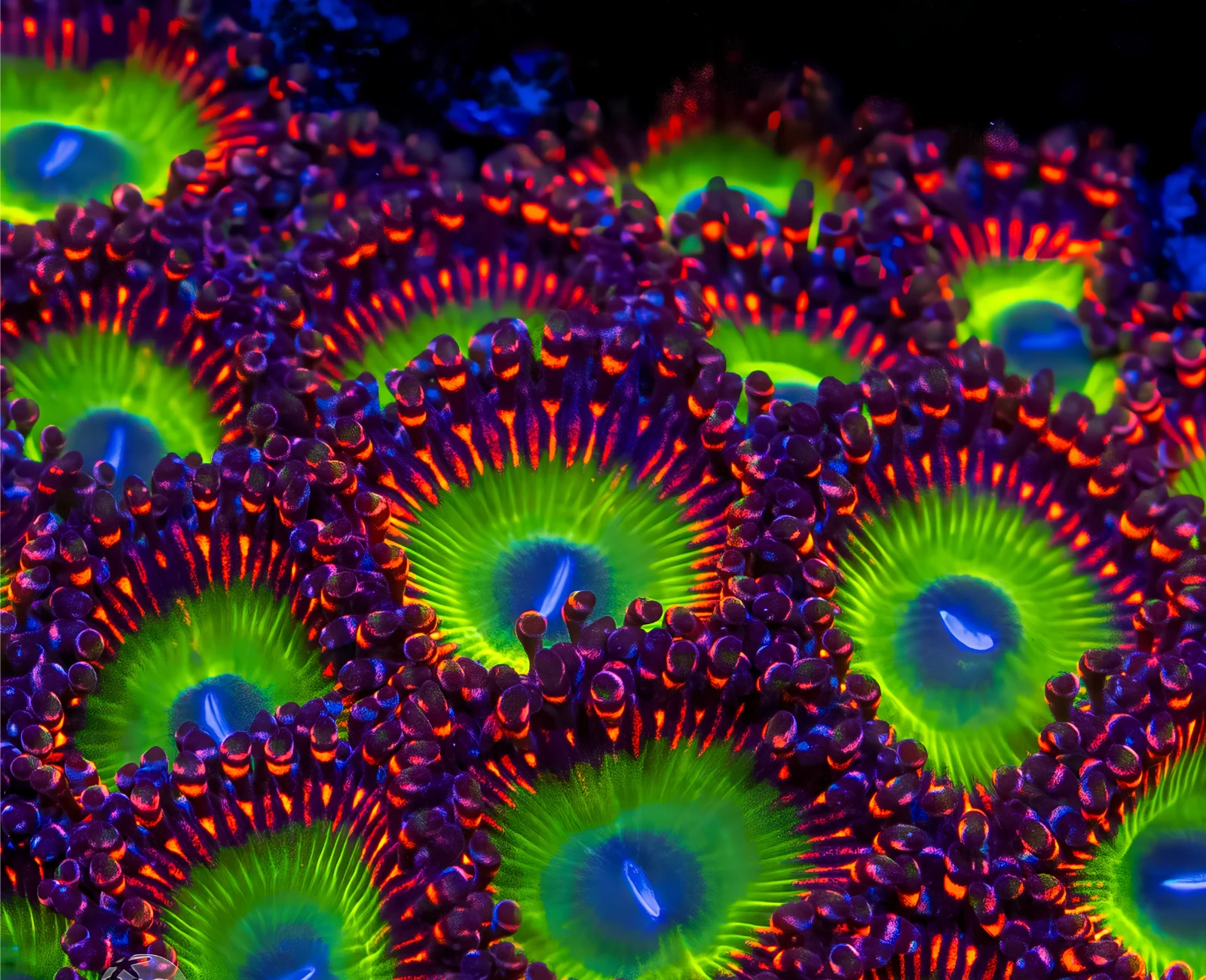
Candy Apple Red
Candy Apple Red is a named zoanthid morph recorded in the Zoa Scan UK zoanthid catalogue. It is also recorded under the alias CAR. Its observed colour profile combines a purple centre, green body or oral disc and red skirt, arranged in a concentric pattern. These recorded traits help reefkeepers compare specimens, although appearance can vary with aquarium lighting, photography and colony condition. Zoa Scan records this morph as easy in difficulty, with moderate lighting and low–moderate water flow, together with a fast growth rate. These care details are catalogue observations rather than guarantees, so stable reef conditions and gradual acclimation remain important. Use this profile to identify Candy Apple Red zoanthids, compare current UK retailer observations and review captive-grown community frags. Check the complete colour pattern and available source evidence rather than relying on the trade name alone.
Open catalogue record →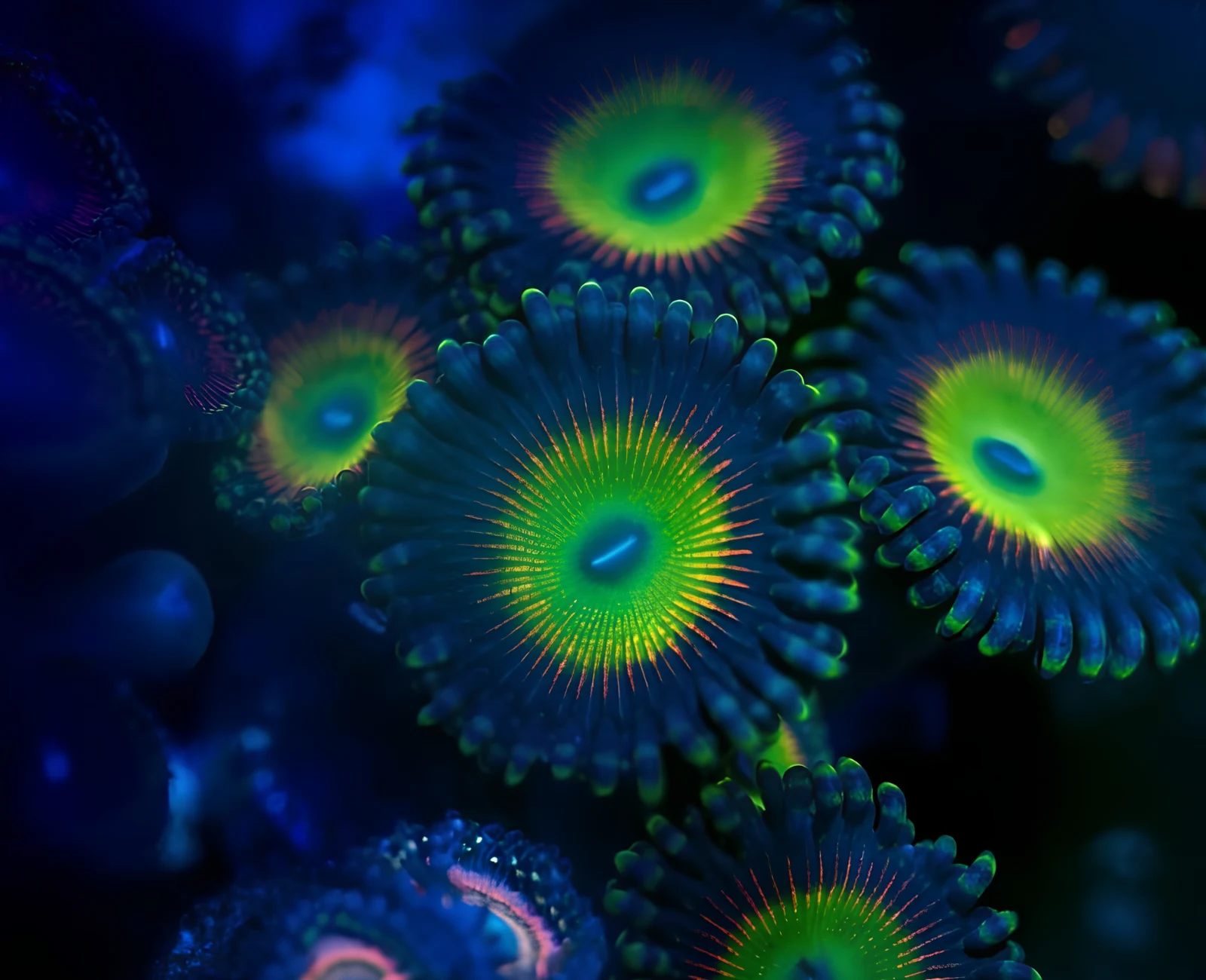
Candy Apple
Candy Apple is a named zoanthid morph recorded in the Zoa Scan UK zoanthid catalogue. Its observed colour profile combines a green centre, purple body or oral disc and green skirt, arranged in a concentric pattern. These recorded traits help reefkeepers compare specimens, although appearance can vary with aquarium lighting, photography and colony condition. Zoa Scan records this morph as moderate in difficulty, with low-moderate lighting and low-moderate water flow, together with a moderate growth rate. These care details are catalogue observations rather than guarantees, so stable reef conditions and gradual acclimation remain important. Use this profile to identify Candy Apple zoanthids, compare current UK retailer observations and review captive-grown community frags. Check the complete colour pattern and available source evidence rather than relying on the trade name alone.
Open catalogue record →Why Lighting Makes Zoanthid Identification Difficult
Aquarium lighting can dramatically change the way a zoanthid appears.
Many zoanthids contain fluorescent pigments that become especially vivid beneath blue or actinic reef lighting. Colours that appear extremely bright under deep blue lighting may look much more subdued when viewed under a whiter spectrum.
The reverse can also happen. Details that are difficult to see under heavy blue lighting may become much clearer when additional white light is present.
Lighting intensity can influence appearance too, particularly over time.
For that reason, photographs taken in two different aquariums should not be expected to match perfectly.
Camera Settings Can Change What You See Too
A photograph is not always a neutral record of the coral.
White balance, exposure, saturation, filters and post-processing can all affect the appearance of a zoanthid image.
Reef photography is particularly challenging because blue aquarium lighting can overwhelm a camera's automatic white balance.
This does not mean edited photographs are necessarily misleading. Correcting white balance can actually make an image look more like the coral appeared to the photographer.
The problem arises when colour is pushed so far that the photograph no longer represents a realistic appearance.
When identifying a morph from photographs, use several sources whenever possible rather than relying on one unusually saturated image.
Polyp Shape and Size
Polyp size can provide another clue, but it should be treated cautiously.
The apparent size and shape of a zoanthid can change depending on light, flow and how fully it is extended. A colony stretching towards weaker light may look very different from the same morph growing flatter under stronger illumination.
Young polyps may also be smaller than established adults within the same colony.
Use polyp size as supporting information rather than a deciding characteristic.
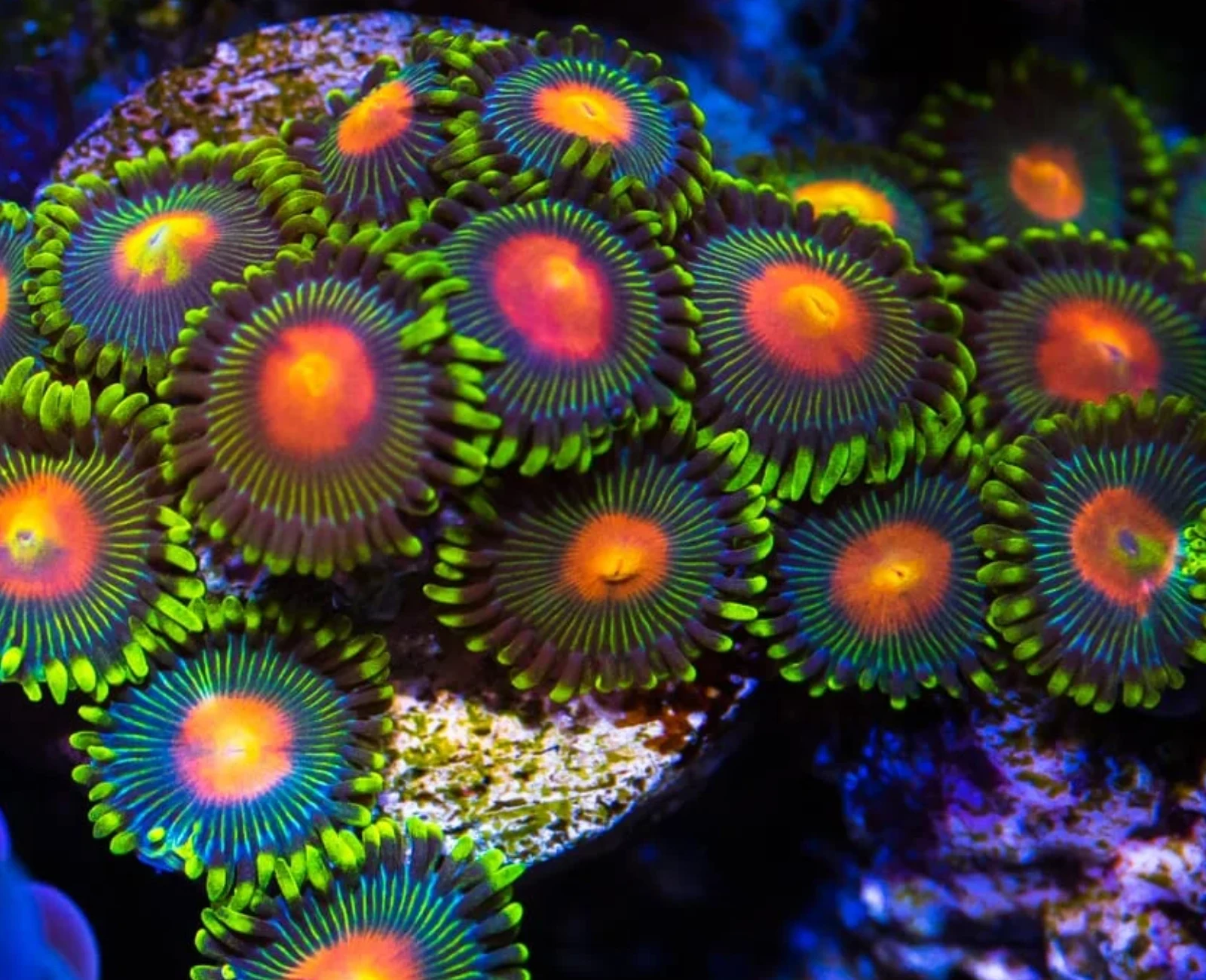
Green Packer
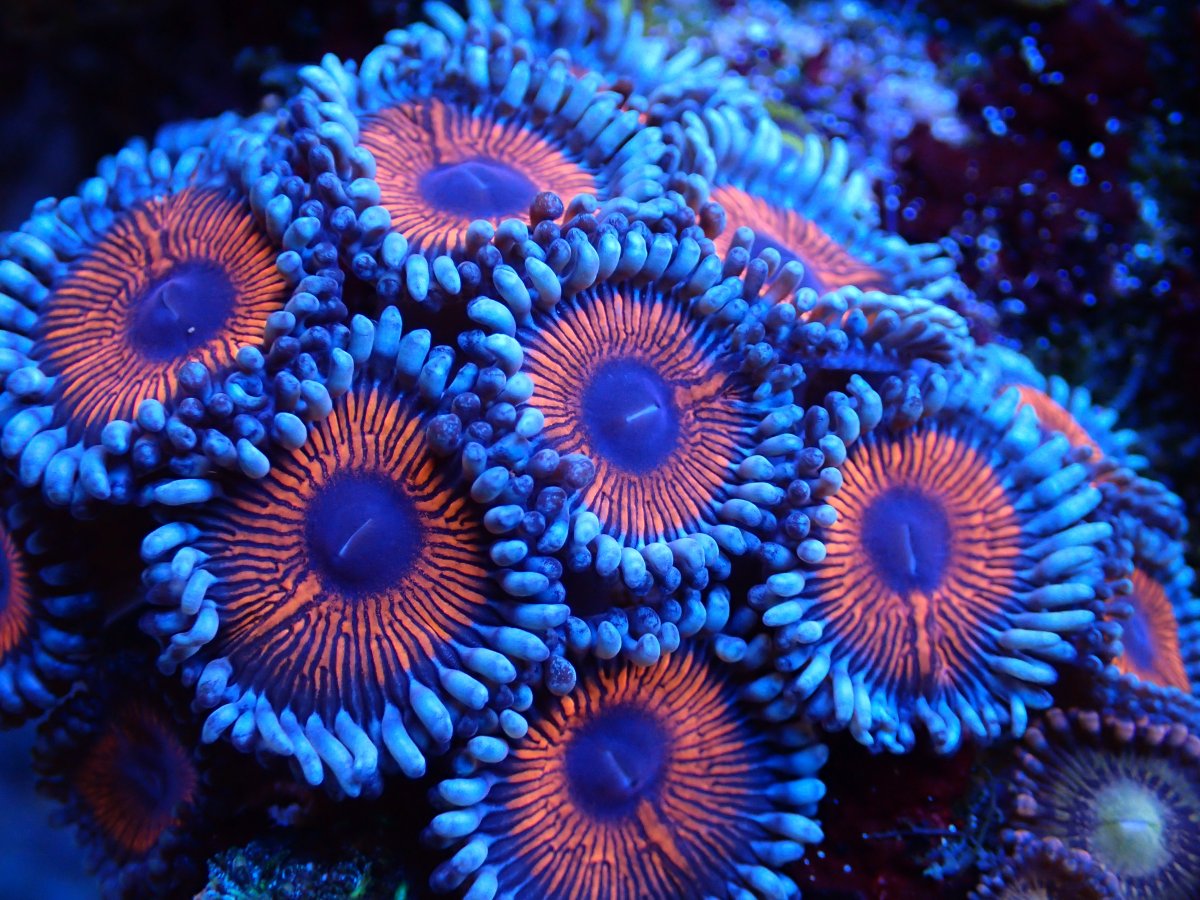
Green Packer is a named zoanthid morph recorded in the Zoa Scan UK zoanthid catalogue. It is also recorded under the alias Green Bay Packer. Its observed colour profile combines a orange centre, green body or oral disc and green skirt, arranged in a ringed pattern. These recorded traits help reefkeepers compare specimens, although appearance can vary with aquarium lighting, photography and colony condition. Zoa Scan records this morph as easy in difficulty, with low-moderate lighting and low-moderate water flow, together with a moderate growth rate. These care details are catalogue observations rather than guarantees, so stable reef conditions and gradual acclimation remain important. Use this profile to identify Green Packer zoanthids, compare current UK retailer observations and review captive-grown community frags. Check the complete colour pattern and available source evidence rather than relying on the trade name alone.
Open catalogue record →Look at More Than One Polyp
Whenever possible, identify a zoanthid using a colony or a frag containing several open polyps.
A single polyp may display an unusual marking, be partially closed or simply photograph differently from its neighbours.
Several polyps allow you to identify which characteristics are consistent across the colony.
Look for repeating:
- - Centre colours
- - Ring patterns
- - Skirt colours
- - Speckles or streaks
- - Polyp shape
- - Overall colour arrangement
Small variations between individual polyps are normal. What matters most is the pattern that repeatedly appears across the colony.
Why the Same Morph Can Look Different
One of the biggest traps in zoanthid identification is expecting every specimen carrying the same trade name to look identical.
Appearance can be influenced by:
- - Lighting spectrum
- - Lighting intensity
- - Camera white balance
- - Exposure
- - Polyp maturity
- - Whether the polyp is fully open
- - Water flow
- - Aquarium conditions
- - Viewing angle
- - Photography and post-processing
Small visual differences therefore do not automatically mean you have discovered a different morph.
Equally, two zoanthids sharing similar colours are not automatically the same morph.
Identification is about the combination of characteristics.
Understanding Zoa Trade Names
Names such as Sunny D, Candy Apple Red and Fruit Loops are collector and trade names.
They are extremely useful within the hobby because they give reefkeepers a shared vocabulary for recognisable colour morphs. However, they should not be confused with formal scientific names.
There is no universal authority assigning every zoanthid trade name.
The same or very similar zoanthid may occasionally circulate under more than one name, and the same name may sometimes be applied inconsistently.
This is one reason Zoa Scan treats identification as a catalogue and comparison process rather than pretending every hobby name represents a scientifically defined animal.
Zoanthus, Palythoa and Hobby Terminology
The word "zoa" is often used very loosely within the reefkeeping hobby.
Scientifically, zoantharians belong to a much larger group containing multiple genera, including familiar names such as Zoanthus and Palythoa.
Visual appearance alone is not always sufficient for reliable scientific identification, so hobby morph identification and biological taxonomy should be treated as different things.
Zoa Scan's morph catalogue is primarily designed to help reefkeepers navigate hobby-recognised morphs, not to provide species-level taxonomic determinations.
A separate Zoa vs Palythoa Guide will explore this subject in more detail.
What If Two Zoas Look Almost Identical?
This is where identification becomes difficult.
If two candidate morphs look similar, compare them systematically rather than switching repeatedly between photographs.
Start at the mouth and work outwards.
- 1. Compare mouth colour.
- 2. Compare the immediate centre.
- 3. Look for inner rings.
- 4. Compare the main oral disc colour.
- 5. Look for streaks, speckles or gradients.
- 6. Compare the outer ring.
- 7. Compare skirt colour and tentacle pattern.
- 8. Look at several polyps rather than one.
- 9. Compare photographs under more than one lighting spectrum if available.
- 10. Be willing to leave the identification uncertain if the evidence is not strong enough.
Use Colony Appearance as a Final Check
Once the individual polyp looks like a potential match, zoom back out and compare the colony as a whole.
Ask whether the candidate morph has a similar overall appearance when several polyps are open together.
Some patterns that look convincing in an extreme macro photograph become less convincing when viewed across an entire colony.
Colony photographs are therefore particularly useful alongside close-up identification images.
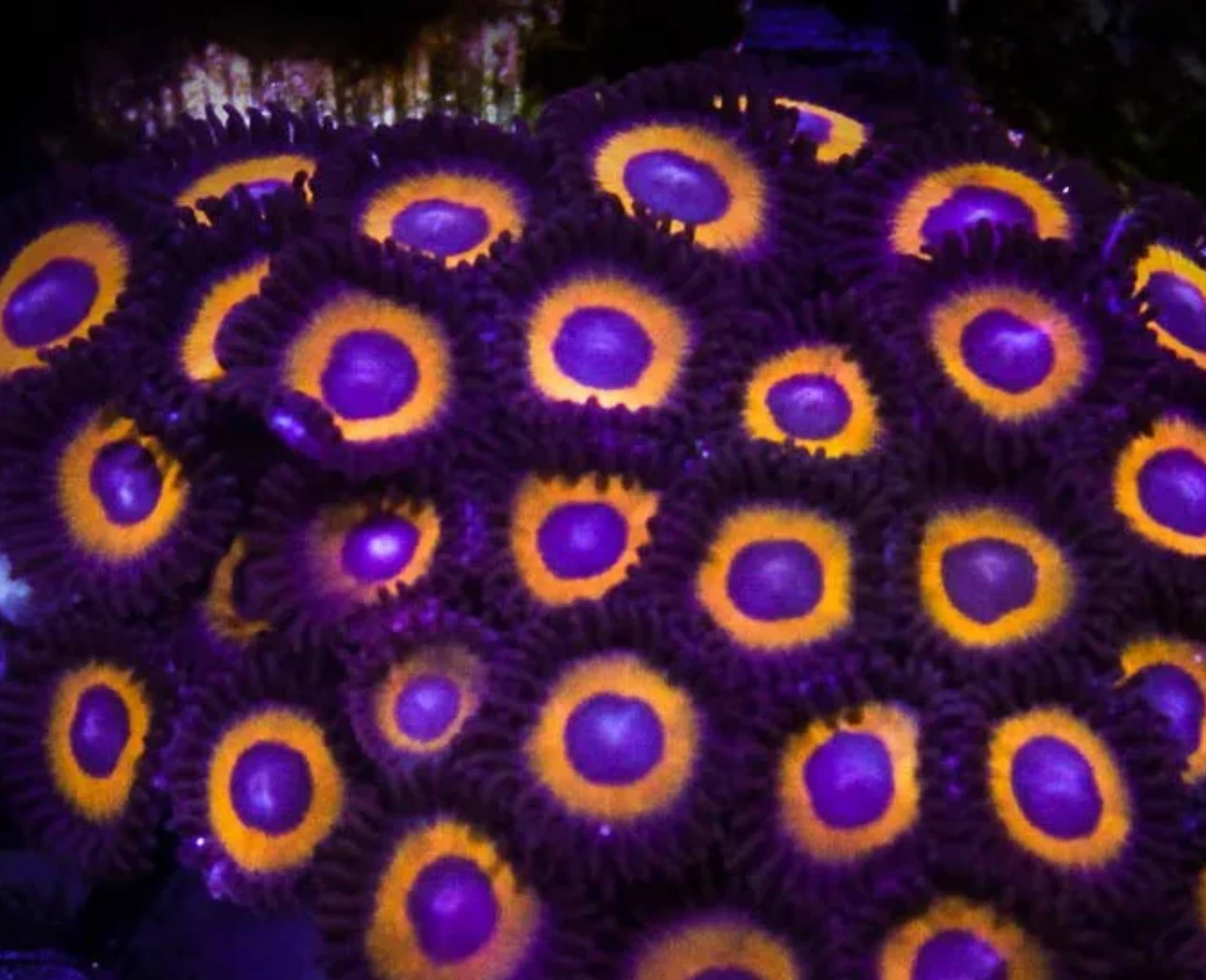
Johnny Pumpkin Seeds
Johnny Pumpkin Seeds is a named zoanthid morph recorded in the Zoa Scan UK zoanthid catalogue. Its observed colour profile combines a purple centre, orange body or oral disc and brown skirt, arranged in a ringed pattern. These recorded traits help reefkeepers compare specimens, although appearance can vary with aquarium lighting, photography and colony condition. Zoa Scan records this morph as easy in difficulty, with low-moderate lighting and low-moderate water flow, together with a moderate growth rate. These care details are catalogue observations rather than guarantees, so stable reef conditions and gradual acclimation remain important. Use this profile to identify Johnny Pumpkin Seeds zoanthids, compare current UK retailer observations and review captive-grown community frags. Check the complete colour pattern and available source evidence rather than relying on the trade name alone.
Open catalogue record →How to Photograph a Zoa for Identification
A good photograph makes identification much easier.
You do not need specialist macro equipment, but the image should show the polyp clearly enough to distinguish its main colour zones.
For the best chance of identification:
- - Wait until the polyp is fully open.
- - Photograph the coral through clean aquarium glass.
- - Hold the camera square to the glass where possible.
- - Avoid digital zoom if it destroys detail.
- - Focus on the oral disc rather than the surrounding rock.
- - Take one close-up and one wider colony photograph.
- - Include a photograph under a reasonably balanced spectrum if possible.
- - Avoid excessive saturation when editing.
- - Take several frames because small focus differences matter at close range.
If you regularly photograph zoanthids, consistency is extremely valuable.
Using similar lighting, white balance and processing across your photographs makes comparison between morphs much easier.
We will cover this in much more detail in the How to Photograph Zoanthids Guide.
How to Use Zoa Scan to Identify a Morph
Zoa Scan is designed to make the comparison process easier.
Rather than scrolling randomly through hundreds of photographs, use the visible characteristics of your zoa to narrow down possible matches.
Pay particular attention to the same information recorded throughout the catalogue, including centre, body and skirt colour.
Once you find a potential match, open the full morph page and compare the entire pattern rather than relying on the catalogue thumbnail alone.
- 1. Photograph your unknown zoanthid while fully open.
- 2. Identify its main centre, body and skirt colours.
- 3. Browse or search the Zoa Scan morph catalogue.
- 4. Open likely matches.
- 5. Compare the mouth and centre first.
- 6. Compare rings and oral disc markings.
- 7. Compare the skirt.
- 8. Look at all available photographs.
- 9. Use Zoa Match or the comparison tools where helpful.
- 10. Leave the morph unidentified if there is not enough evidence for a confident match.
Common Zoanthid Identification Mistakes
- - Matching a morph from its dominant colour alone
- - Relying on one photograph
- - Comparing images taken under completely different lighting without accounting for spectrum
- - Assuming every retailer uses exactly the same trade names
- - Treating trade names as scientific species
- - Identifying a partially closed polyp
- - Ignoring the skirt
- - Ignoring small rings and markings around the centre
- - Overlooking differences across several polyps
- - Assuming two differently named morphs must be biologically different
- - Forcing an identification when the evidence is inconclusive
Building Confidence in an Identification
The strongest identification comes from several characteristics agreeing with one another.
A candidate becomes much more convincing when the mouth, centre, oral disc pattern, skirt and overall colony appearance all match.
Think in terms of confidence rather than absolute certainty.
You might describe an identification as:
- - Strong match: Multiple distinctive features agree.
- - Likely match: Most important features agree but photography or lighting leaves some uncertainty.
- - Possible match: Similar colour family and pattern, but there are unresolved differences.
- - Unknown: Not enough evidence for a responsible identification.
There is nothing wrong with keeping an attractive zoanthid without knowing its trade name.
The name is useful for cataloguing and communication, but the coral does not become any less interesting because its identity is uncertain.
Frequently Asked Questions
Can You Identify a Zoanthid From a Photo?
Often you can narrow a zoanthid down to a likely hobby morph from good photographs, particularly when the morph has distinctive colour and pattern characteristics.
Confidence is much lower when the photograph is heavily blue, poorly focused, shows only a partially open polyp or when several named morphs are visually very similar.
Why Does My Zoa Look Different From Photos Online?
Different lighting spectra, intensity, cameras, white balance and aquarium conditions can all change how a zoanthid appears.
Compare the position and shape of colour patterns rather than expecting every photograph to have identical colour.
Are Zoa Morph Names Scientific?
No. Familiar morph names are hobby and trade names used to distinguish recognisable appearances.
They are useful for collectors but should not be treated as scientific species classifications.
Can One Zoa Have More Than One Name?
It can happen. The zoanthid trade is decentralised, and similar or apparently identical morphs can occasionally circulate under different names.
Aliases and disputed naming are therefore worth documenting rather than automatically assuming every name represents a genuinely different morph.
Can the Same Named Morph Look Different?
Yes. Some variation in colour and appearance is expected between different aquariums and photographs.
The most useful comparison is the complete recurring pattern across the polyp rather than the exact brightness or shade of one colour.
What Should I Do If I Cannot Identify My Zoa?
Keep it listed as unknown and take better photographs as the colony settles and grows.
An uncertain identification is preferable to adding an incorrect name that could then be repeated by other hobbyists.
Identification Is About the Whole Polyp
Zoanthid identification becomes much easier once you stop asking "what colour is it?" and start asking where are the colours, how are they arranged and which characteristics repeat across the colony?
Work from the centre outwards. Compare the mouth, oral disc, rings, markings and skirt. Allow for differences caused by aquarium lighting and photography, and remember that hobby trade names are not formal scientific classifications.
Most importantly, do not force a match.
The aim of Zoa Scan is not simply to put a name on every polyp. It is to build a useful, community-led catalogue that makes zoanthid identification more consistent, transparent and enjoyable.