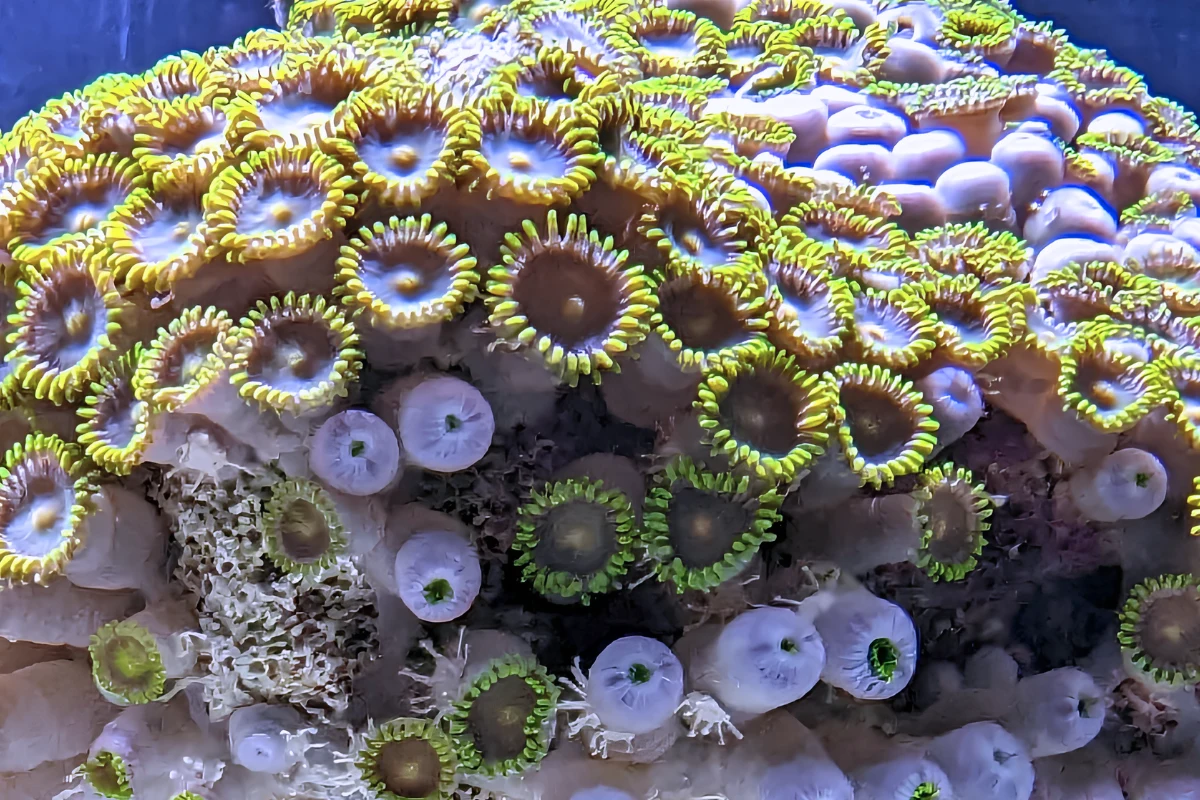
A zoanthid colony that suddenly stops opening can make it feel as though something has gone badly wrong overnight.
Sometimes there really is a pest involved. Zoanthids have several well-known predators, including zoa-eating nudibranchs, sundial snails and sea spiders. But closed or declining zoas can also be caused by something much simpler, including a recent move, excessive flow, lighting changes, accumulated detritus or unstable water conditions.
The important thing is not to immediately assume the worst.
Good troubleshooting starts by looking at what changed, examining the colony closely and working through the possible causes one at a time.
Are Closed Zoanthids Always a Problem?
No.
Individual zoanthid polyps regularly close when disturbed. A fish brushing past the colony, maintenance in the aquarium, sediment landing on the polyps or simply moving a frag can cause temporary closure.
Newly introduced zoanthids may also take time to settle after transport and a change in lighting, flow and water chemistry.
It becomes more concerning when a colony that normally opens reliably remains closed for an extended period, progressively loses polyps or shows visible tissue damage.
| What you see | Possible explanation |
|---|---|
| One or two polyps briefly closed | Normal irritation or disturbance |
| New frag closed after introduction | Transport and acclimation stress |
| Colony closes when flow increases | Excessive or direct flow |
| Colony changes after moving higher | Possible lighting stress |
| Several polyps repeatedly closed | Irritation, pest or environmental issue |
| Polyps disappearing | Investigate predation or tissue loss |
| White spots or pustules on tissue | Possible zoa pox-like condition |
| Algae growing between polyps | Detritus, nutrients, low flow or local irritation |
| Colony rapidly deteriorating | Investigate immediately |
This table is intended as a troubleshooting starting point, not a diagnosis.
Start With the Obvious Things
Before reaching for a coral dip, look at the aquarium.
Ask what has changed during the last few days or weeks.
- Has the zoanthid recently been moved?
- Has the lighting intensity changed?
- Has the lighting schedule changed?
- Has the flow pattern changed?
- Has another coral grown close enough to touch it?
- Have temperature or salinity fluctuated?
- Has the colony been fragged recently?
- Has algae begun growing around the polyps?
- Is detritus accumulating between the polyps?
- Have you added any fish, crabs, snails or other livestock?
- Is the problem affecting one colony or several corals?
How to Inspect a Zoanthid Colony
Many zoanthid pests are small, well camouflaged or most active when the aquarium lights are off.
A quick look from the front of the tank is not always enough.
If the frag can be safely removed, inspect it somewhere brightly lit. Examine the polyps, the tissue between them, the sides and underside of the frag plug and any small holes or crevices.
- Look at the colony while the polyps are open.
- Note which polyps are consistently closed.
- Inspect the spaces between the polyps.
- Look underneath the frag plug.
- Check for eggs, snails or unusual moving animals.
- Inspect the colony again after the aquarium lights have been off for a while.
- Use a small torch to check the rock immediately surrounding the colony.
- Photograph anything suspicious before removing it if identification is uncertain.
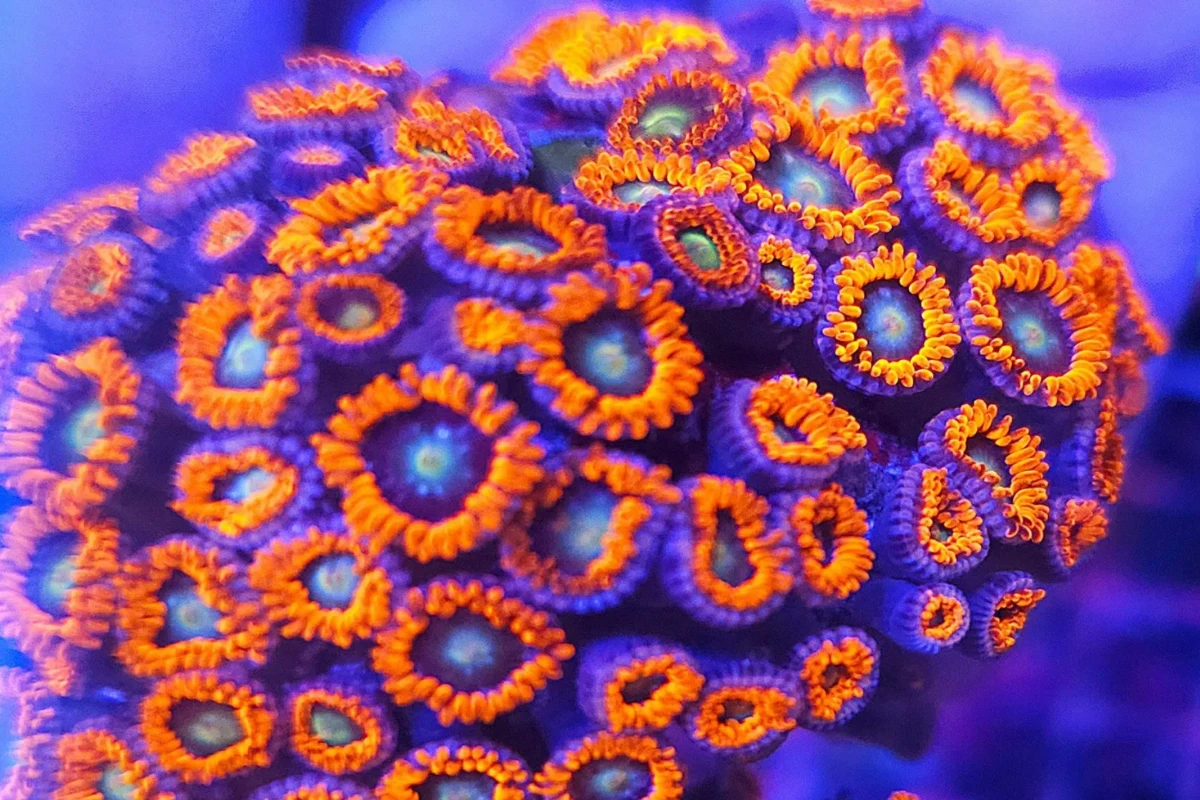
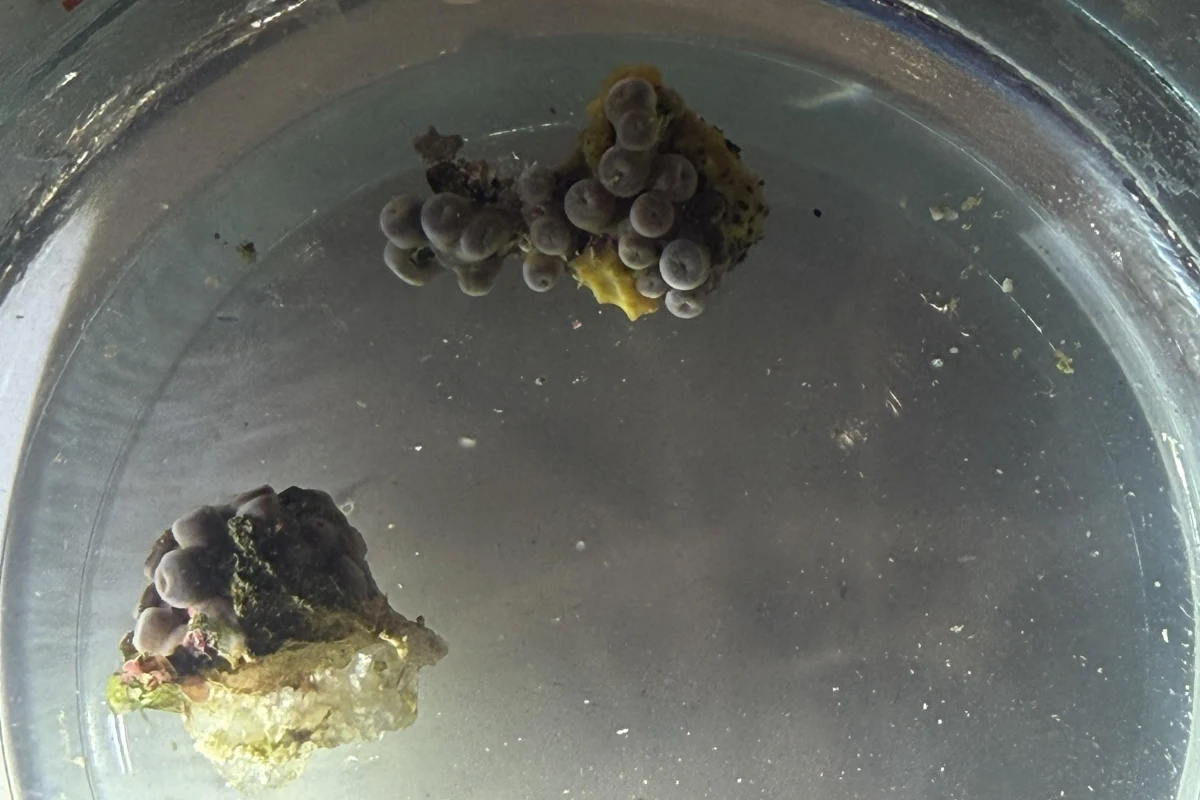
Zoa-Eating Nudibranchs
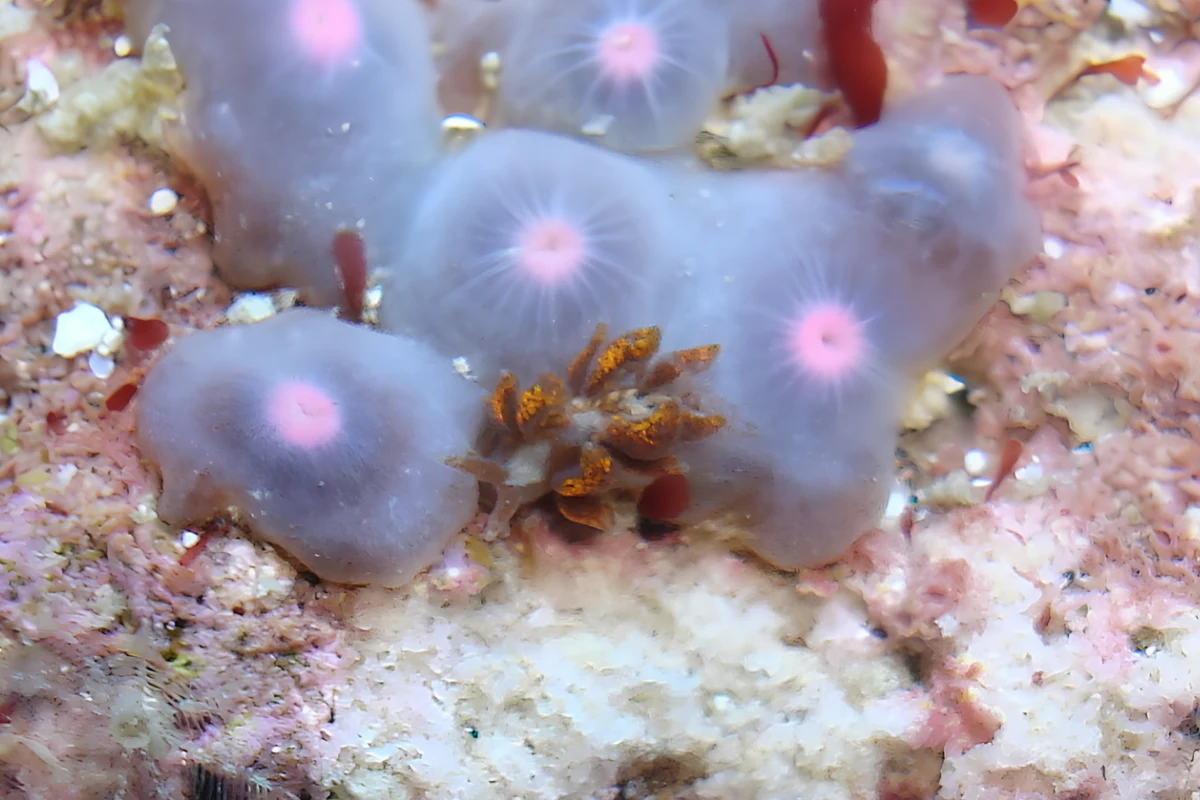
Zoanthid-eating nudibranchs are among the best-known specialist pests associated with zoa colonies.
They are small sea slugs that feed on zoanthids and can be remarkably difficult to spot because their appearance can blend into the colony they are feeding on.
Their cerata, the finger-like structures covering their backs, can resemble the skirt of a zoanthid polyp. Their colour can also make them surprisingly inconspicuous among the polyps.
Signs of Zoa-Eating Nudibranchs
- Individual polyps remain closed repeatedly
- Closed areas gradually spread through the colony
- Small slug-like animals are visible between polyps
- Polyps appear damaged or disappear
- Pests are easier to spot after lights-out
- Small spiral or coiled egg masses may be present around the colony
Sundial Snails
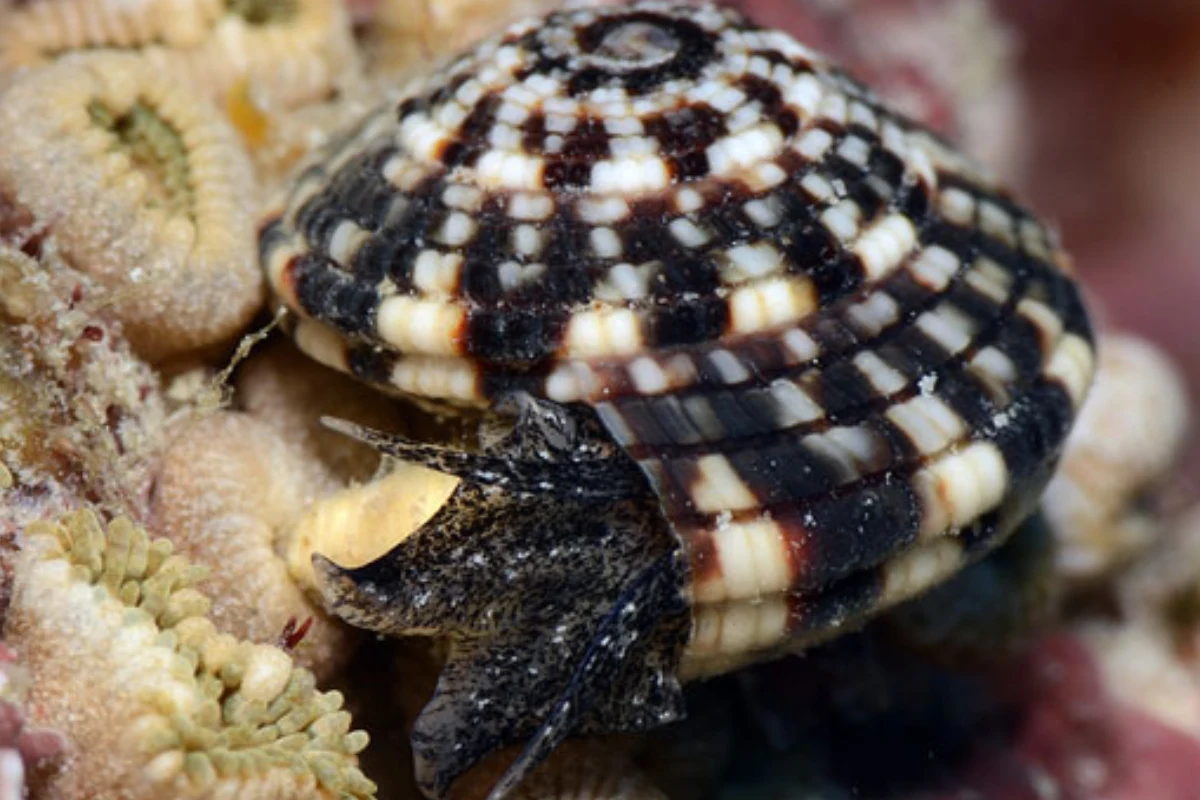
Sundial snails are another well-known zoanthid predator.
They are usually recognised by their distinctive flattened, rounded shell with a strongly contrasting pattern. Their exact appearance can vary, so identification should not be based on colour alone.
They are often found directly among or underneath zoanthid colonies where they feed on the polyps.
Unlike a tiny harmless snail simply passing over a colony, finding a genuine sundial snail among declining zoanthids deserves attention.
What to Look For
- Small patterned snail within the zoanthid colony
- Flattened or disc-like shell
- Polyps disappearing around the area where the snail is found
- Snails hiding underneath the colony or rock
- Repeated closure and damage without another obvious cause
Zoanthid Sea Spiders
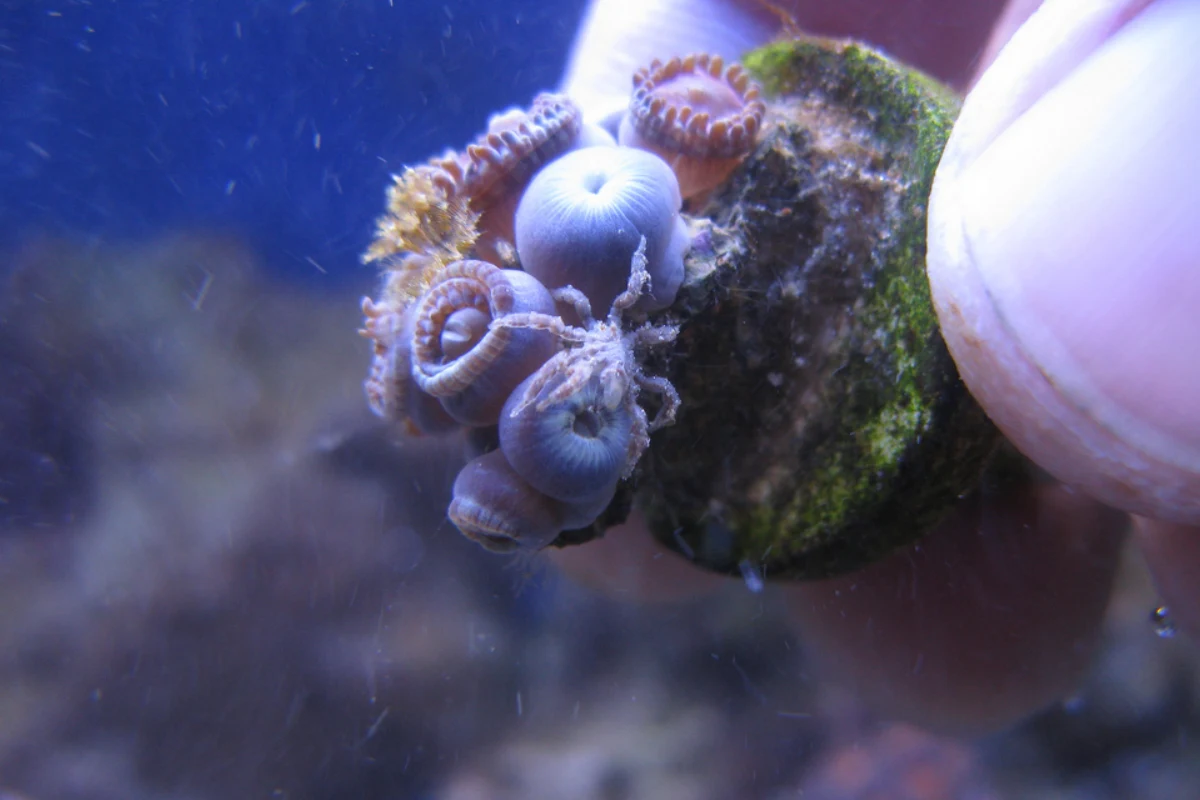
Sea spiders are less commonly encountered than zoa-eating nudibranchs, but they are another pest worth recognising.
Despite the name, they are not true spiders. They are marine arthropods belonging to a group called pycnogonids.
Their long, thin legs can make them look like a miniature spider crawling between the polyps.
Because they can hide among the colony and rockwork, they may be difficult to see during a quick daytime inspection.
- Repeatedly closed polyps
- Unexplained polyp loss
- Small spider-like animals amongst the colony
- Activity noticed after lights-out
- Problems associated with newly acquired colonies
What About Asterina-Type Starfish?
Small hitchhiking starfish commonly grouped by reefkeepers under the name "Asterina" are a much less straightforward subject.
Many small starfish in reef aquariums spend their time grazing films from rock and glass and cause no obvious problems.
There are, however, hobby reports of some individuals appearing to damage or consume coral tissue, including zoanthids.
For this reason, finding a small starfish sitting on a closed zoa does not prove that it caused the problem.
Watch the animal's behaviour and look for repeated evidence before deciding it is responsible.
Zoa Pox
"Zoa pox" is the hobby name given to a condition in which small pale or white raised spots appear on the stalk or tissue of affected zoanthids.
Affected colonies may remain closed, deteriorate or lose polyps.
Despite the familiar hobby name, it should not be treated as though every white mark on a zoanthid has one confirmed cause.
The appearance can be distinctive, but the underlying cause and best treatment are not always straightforward.
- Small white or cream raised spots on the sides of polyps
- Multiple affected polyps within one colony
- Persistent closure
- Reduced extension
- Progressive deterioration of affected tissue
Algae Growing Around Zoanthids
Algae does not need to eat a zoanthid to become a problem.
Filamentous algae, turf algae and films can grow around the base of a colony, trap debris and physically irritate polyps.
Once algae becomes established between tightly packed zoas, the colony itself can make access difficult.
The best solution is usually to address both the algae growing directly around the coral and the conditions allowing it to persist.
- Whether detritus is collecting around the colony
- Whether flow reaches the area effectively
- Whether nuisance algae is growing elsewhere in the aquarium
- Whether the frag plug itself is heavily overgrown
- Whether neighbouring polyps are being physically smothered
Be Gentle When Cleaning Around Zoas
Physical cleaning can help, but avoid aggressively scrubbing living zoanthid tissue.
If a removable frag plug is badly overgrown, it may be easier to clean the exposed plug and surrounding hard surface away from the display aquarium.
Take appropriate personal protection whenever handling zoanthids.
Detritus Between the Polyps
Dense zoanthid colonies can trap food, waste and other debris between their polyps.
Moderate water movement normally helps prevent material from settling for long periods.
If one part of a colony repeatedly fills with debris, review the local flow rather than simply blowing the colony clean every day.
A turkey baster or similar gentle flow of aquarium water can be useful for removing loose material during maintenance.
Flow Problems
Both excessive and insufficient flow can cause trouble.
A zoanthid being blasted continuously from one direction may remain closed or struggle to expand normally.
Too little water movement can allow debris and algae to accumulate between the polyps.
A healthy colony should normally show movement without appearing permanently flattened by the current.
If the problem started after changing a wavemaker, moving a pump or repositioning the frag, flow should be high on the troubleshooting list.
Lighting Problems
A sudden change in lighting can cause a healthy zoanthid colony to behave differently.
This is particularly important when a newly purchased frag moves from relatively modest lighting straight into a high-PAR position.
Possible signs of light-related stress include prolonged closure or paling following a substantial increase in intensity.
At the other extreme, zoanthids in very low light may stretch strongly towards the light source.
If you suspect lighting, refer to the Zoanthid Lighting Guide and make changes gradually.
Water Parameter Instability
Zoanthids are often described as hardy, but hardy does not mean immune to sudden environmental change.
Rapid changes in salinity or temperature can upset a colony, as can major swings in alkalinity or other aquarium chemistry.
If several colonies or unrelated corals become unhappy at the same time, test the aquarium before assuming every colony has independently developed a pest problem.
- Temperature
- Salinity
- Alkalinity
- pH where relevant
- Nitrate
- Phosphate
- Ammonia if there is any reason to suspect a system problem
Why Is My New Zoa Still Closed?
Transport can be surprisingly stressful for zoanthids.
A coral that was open at the seller may remain closed after shipping or after being moved between aquariums.
If the tissue still looks intact and there is no visible pest or obvious environmental problem, patience may be more useful than repeatedly moving or dipping the colony.
Inspect it carefully, give it appropriate light and flow and monitor its condition.
Could a Fish or Invertebrate Be Irritating the Colony?
Not every problem comes in on the frag plug.
Fish and invertebrates already living in the aquarium can occasionally disturb zoanthids.
Sometimes this is accidental. A hermit crab may climb through a colony, a snail may cross it or a fish may repeatedly investigate a new frag.
In other cases an animal may nip at the polyps.
The best evidence is direct observation.
If the same fish or invertebrate repeatedly approaches the affected colony and the polyps close immediately afterwards, watch closely before blaming an invisible pest.
Neighbouring Corals Can Be the Problem
As a reef aquarium matures, corals that were comfortably separated can eventually come into contact.
Sweeper tentacles, direct physical contact or aggressive neighbouring corals may irritate zoanthids.
Check what happens after the lights go out as well as during the daytime because some corals extend further at night.
Also remember that the zoanthid colony itself may have grown towards the neighbouring coral.
What Does "Zoa Melting" Mean?
Reefkeepers often use the phrase "melting" when a zoanthid colony rapidly loses tissue and polyps begin collapsing or disappearing.
It describes what the colony looks like, not a specific diagnosis.
Several different problems may eventually produce a similar appearance, including severe stress, tissue damage, infection, pests or deteriorating environmental conditions.
Treat "melting" as a sign that the colony is in serious trouble rather than as the name of one particular disease.
Should You Dip a Troubled Zoanthid?
A coral dip can be extremely useful when a removable zoanthid frag has a suspected external pest.
It should not, however, be treated as a universal cure for every closed colony.
Commercial dips vary in their ingredients, concentrations and instructions. Use the manufacturer's directions for the specific product rather than improvising stronger concentrations or longer exposure times.
A dip may dislodge mobile pests while leaving eggs attached to the coral or plug.
Our separate How to Dip Zoanthids Guide will cover inspection, dipping, rinsing, repeat checks and the limitations of dipping in more detail.
Why One Dip May Not Be Enough
A treatment can appear successful because the visible mobile pests disappear, only for the problem to return later.
One important reason is that pest eggs may remain attached to the colony or plug.
Zoa-eating nudibranch egg masses are a particular example. Removing the adults without finding and removing the eggs can allow another generation to emerge.
This is why inspection over time is just as important as the initial treatment. Tidal Gardens similarly notes that nudibranch eggs can survive typical dips and contribute to recurring infestations.
Quarantine Is Easier Than Eradication
The easiest pest infestation to deal with is the one that never enters the display aquarium.
A separate coral quarantine system allows new zoanthids to be inspected over time rather than relying entirely on what can be seen on the day they arrive.
Even without a full quarantine system, careful inspection and an appropriate dipping routine can reduce the chance of introducing unwanted hitchhikers.
Wild or recently imported colonies deserve particularly careful inspection because they can arrive with a much wider range of associated organisms.
A Simple Troubleshooting Process
- Do not panic because a few polyps are closed.
- Check whether anything recently changed.
- Look at the rest of the aquarium.
- Test relevant water parameters.
- Inspect the colony closely in good light.
- Check underneath removable frags.
- Look again after lights-out.
- Photograph unidentified animals or marks.
- Remove confirmed visible predators where practical.
- Use an appropriate coral dip if a removable coral has a suspected external pest.
- Inspect for eggs.
- Continue monitoring rather than assuming one treatment solved the problem.
- Avoid making several unrelated aquarium changes at once.
| Problem | First thing to check |
|---|---|
| New frag will not open | Acclimation, light and flow |
| One area of colony closed | Local irritation or pest |
| Colony covered in debris | Flow |
| Polyps stretching upwards | Lighting |
| Polyps pale after moving | Possible excess light |
| Polyps disappearing | Predation or severe tissue loss |
| Small slug-like animals | Nudibranch identification |
| Patterned snail among zoas | Sundial snail identification |
| Spider-like animal | Sea spider identification |
| White raised spots | Zoa pox-like condition |
| Algae between polyps | Local algae and flow |
| Several corals unhappy | System parameters |
Common Troubleshooting Mistakes
- Assuming every closed zoa has nudibranchs
- Dipping a colony repeatedly without identifying the problem
- Ignoring egg masses after removing adult pests
- Changing lighting, flow and water chemistry simultaneously
- Treating every tiny snail as harmful
- Blaming a scavenger simply because it is sitting on damaged tissue
- Ignoring the underside of the frag plug
- Inspecting only during the daytime
- Moving the colony every day
- Letting algae and detritus accumulate between polyps
- Assuming a hardy coral cannot be affected by parameter swings
- Waiting too long when polyps are actively disappearing
When Should You Be Concerned?
Temporary closure is common.
Progressive deterioration is different.
Take the problem more seriously when you see:
- Polyps disappearing one after another
- Tissue visibly breaking down
- A pest feeding on the colony
- The affected area growing each day
- Several colonies declining simultaneously
- Severe bleaching
- Rapid loss of tissue
- Persistent closure accompanied by obvious physical damage
Frequently Asked Questions
Why Are My Zoas Closed?
Zoanthids close for many reasons, including normal disturbance, transport, changes in flow or lighting, unstable conditions, algae, neighbouring corals and pests.
Look for recent changes and inspect the colony before assuming there is one specific cause.
What Eats Zoanthids?
Recognised zoanthid predators in reef aquariums include specialised nudibranchs, sundial snails and some sea spiders.
Other aquarium animals may occasionally nip or disturb polyps, but direct observation is preferable to assuming an animal is responsible simply because it is nearby. Specialist zoa pests including nudibranchs, sea spiders and sundial snails are also documented in experienced coral husbandry references.
Do Zoa-Eating Nudibranchs Come Out at Night?
They can be easier to find when the aquarium is dark and the colony is being inspected carefully with a torch.
Night-time inspection is useful for many small reef pests because normal daytime activity and open polyps can make them difficult to spot.
Will a Coral Dip Kill Nudibranch Eggs?
You should not assume that it will.
Mobile nudibranchs can be affected by appropriate commercial coral dips, but attached egg masses may survive. Physical inspection and follow-up checks are therefore important.
Are Sundial Snails Bad for Zoas?
True sundial snails associated with zoanthids are recognised predators and should not be left within a zoa colony.
However, many small aquarium snails are harmless grazers, so make sure the animal has been identified correctly before removing it.
What Are the White Spots on My Zoas?
Raised white or cream spots can resemble the hobby condition commonly called zoa pox, particularly when several affected polyps remain closed.
Not every white spot has the same cause, so examine the colony carefully and document whether the marks are increasing before deciding how to respond.
Should I Dip Zoas That Will Not Open?
Not automatically.
If there is evidence of an external pest, dipping may be appropriate. If the colony is closed because it has just been transported, moved into stronger lighting or placed in unsuitable flow, a dip may add further stress without addressing the cause.
Investigate first.
How Long Can New Zoas Stay Closed?
There is no universal time limit.
Some new zoanthids open quickly while stressed colonies can take considerably longer to settle. Tidal Gardens notes that shipping stress alone can sometimes lead to prolonged closure.
The important question is whether the tissue remains intact and whether the overall condition is stable or deteriorating.
Observe First, Treat Second
Zoanthids have a reputation for being hardy, but there are plenty of things that can make a colony unhappy.
The best troubleshooting approach is systematic.
Look at the aquarium. Check what changed. Inspect the colony closely. Look for pests and eggs. Check the flow, lighting and water conditions. Then respond to the evidence you actually find.
A closed colony does not automatically need medication.
A visible predator should not be ignored.
And one successful dip does not necessarily mean an infestation has ended.
The more familiar you become with how your healthy zoanthids normally look and behave, the easier it becomes to notice when something genuinely changes.